
Search Clark County Public Records
Clark County Public Records are spread across a few county offices, but the trail is easy to follow once you know the right desk. The Register of Deeds handles land and vital records. The Clerk of Courts keeps the case file. The Land Information Office supports parcel maps and land data. The Register in Probate keeps probate materials. If you want a deed, a court copy, a marriage certificate, or a map tied to a parcel, Clark County gives you a direct path. Most searches start with a name, a case number, or a parcel number.
Clark County Overview
Clark County Public Records Sources
The best county starting point is the Register of Deeds in Neillsville. Clark County says that office records, indexes, maintains, and provides access to real estate documents, UCC fixture filings, federal tax liens, military discharges, vital records, and other instruments under Wisconsin statutes. The office began operation on January 1, 1855, so it has deep local roots and a long paper trail.
That office also makes the access rule plain. The purpose of recording is to give constructive notice to the public and preserve title history. That is important for anyone trying to track a property, a transfer, or a family line through land records. Clark County Public Records are not just stored. They are organized so the public can use them.
When a request involves land, the county's GIS / Land Information page adds another layer. It explains that land information includes soils, land ownership, taxes, topography, and parcels under Wisconsin public records law and state land information rules. That is exactly the kind of detail that helps when a public record search needs parcel context instead of just a name.
Clarity matters here. A court record is not the same as a land record. A vital record is not the same as a county clerk file. The county gives you separate offices so you can match the request to the right records room. That saves time and keeps the search focused.
The county home and land pages keep the public record path clear at Clark County Land Information.
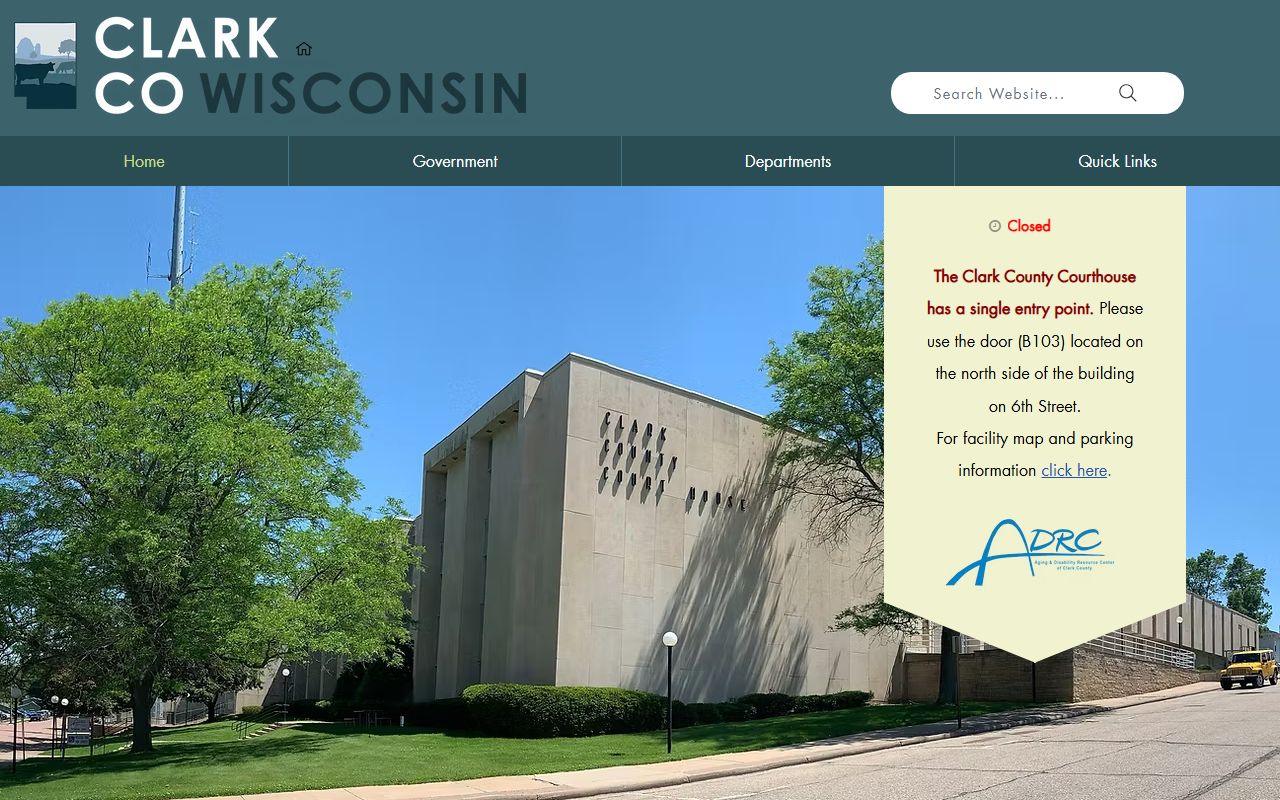
The county website is a useful front door because it points to the offices that actually hold the records and explains how public access works.
How Clark County Public Records Work
The Clerk of Courts is the place to start for case files. Clark County says the office is responsible for the written record of proceedings in the circuit court system, plus collections, court financial management, jury management, and records for appeals, civil cases, criminal cases, family matters, forfeitures, incarcerated persons, small claims, and traffic. The office phone is 715-743-5183, and the courthouse location is 517 Court Street, Room 405, Neillsville.
Basic online court searching still begins with Wisconsin Circuit Court Access. WCCA gives you free case summaries for circuit court matters across Wisconsin. It is the fast way to confirm a case exists before you ask Clark County for a certified copy or a deeper file review. For public records work, that is often enough to separate a live case from a closed one.
Clark County also keeps the county clerk in the chain. The County Clerk's Office is the official record keeper for many county functions, public notices, agendas, and meeting records. That is useful when a request is about county board material, notices, or other county governance records rather than a court file.
For older and slower-moving records, the Land Information Office helps tie records together. It coordinates with the Register of Deeds, Surveyor, and Treasurer to update land information and make it available through the county website. The office also produces hardcopy mapbooks, plat books, emergency service atlases, and parcel atlases. If the county record you need is tied to a map or parcel rather than a case file, this office can be the better route.
Clark County Public Records work best when you follow the record type. Deeds go to the Register of Deeds. Case files go to the Clerk of Courts. Parcel layers and maps go to Land Information. County board records often start with the County Clerk. That simple split helps you ask the right question the first time.
The county also tells people that staff cannot give legal advice. That is not a roadblock. It just means the office will help you find the file, not tell you what the law means for your case.
The county's Register of Deeds page is the main source for land and vital records.
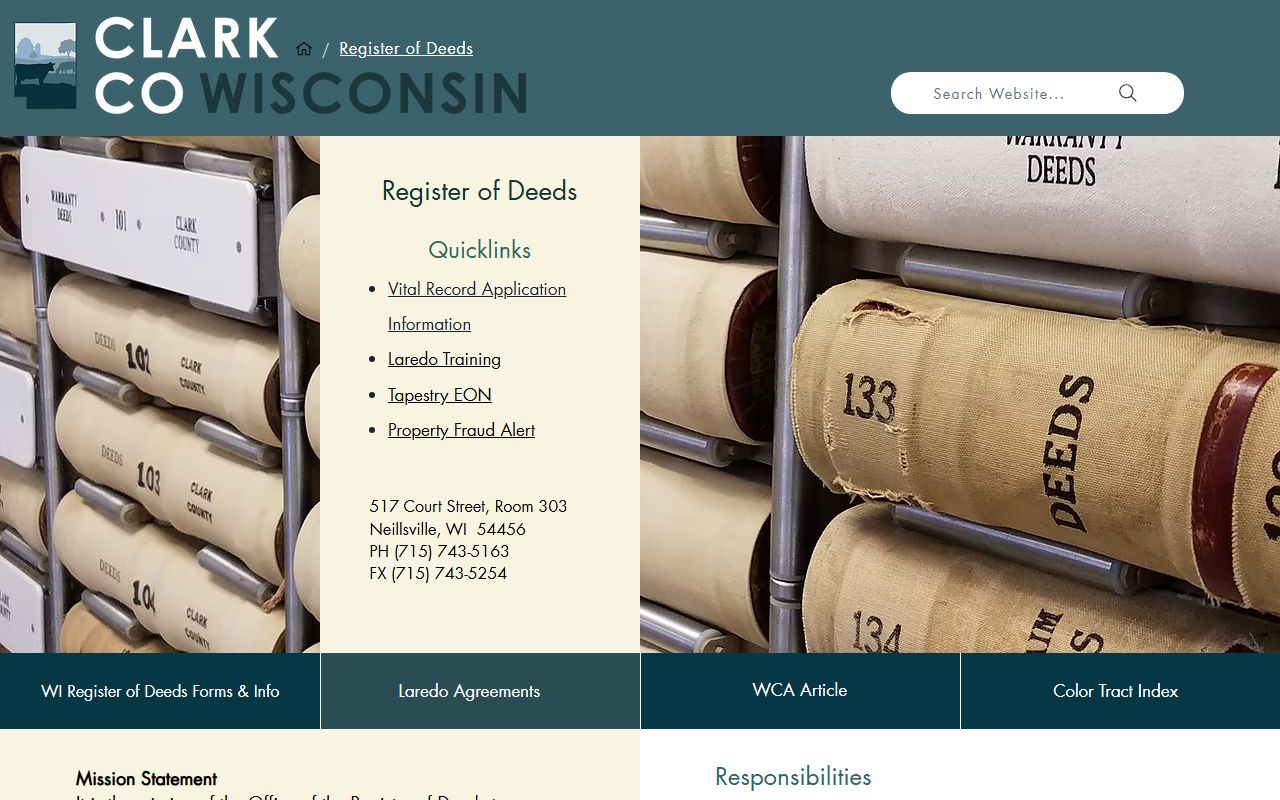
The register office remains the cleanest place to start when the search is about ownership, vital records, or a deed trail.
Clark County Public Records Fees
Clark County's court copy fees are clear and local. The clerk's office charges $1.25 per page for uncertified copies under Wis. Stat. § 814.61 and $5 per document for certified copies under the same statute. That means a simple file pull costs less than a certified paper copy, and the charge depends on what you need the record to do.
The Register of Deeds also provides copies on request. Its public page says certified and non-certified copies are available upon receipt of the proper fee. For mailed vital records, the county's application sheet says each certificate copy costs $20 and each extra copy of the same record ordered at the same time is $3. The same sheet also says requests can be mailed with a stamped envelope and payment to the Register of Deeds.
Land data can carry its own costs. The Land Information Office says GIS data for the entire county costs $50, which includes a flash drive and shipping. Printed map prices are listed by size, and special projects or data analysis are billed at $50 per hour. If your Public Records search depends on a map book, an atlas, or parcel data, that pricing matters.
The county's mix of fees shows why it helps to know the office first. A court search, a deed copy, a vital record request, and a parcel map are all public, but they are not priced the same way. Clark County makes that difference visible across its office pages.
When a request crosses from one office to another, ask each office what its own fee schedule is before you mail payment. That keeps the request clean and avoids delays.
For broad Wisconsin guidance, the DOJ Office of Open Government is still the statewide backup. It is useful when you want the general public records framework behind a county request.
Clark County Offices and Records
The Register of Deeds at 517 Court Street, Room 303, Neillsville, is the county's land and vital records office. It records and indexes real estate documents, federal tax liens, military discharges, and records of births, deaths, and marriages. The office says those records are open to the public except for non-marital births and military discharges. That makes it one of the most important Public Records offices in the county.
The office also connects the past and present. The county says the register began operation in 1855, and the office's work still includes constructive notice and title history. If you are checking ownership or a life event, that historical depth can matter as much as the copy itself.
The Clerk of Courts is at 517 Court Street, Room 405, and keeps the court record. The office hours are Monday through Friday, 8:00 a.m. to 4:30 p.m. If you need an appeal file, a family matter, a traffic record, or a certified case copy, that is the desk to use.
The Land Information Office is at Room 103 and supports parcel maps, data, plat books, and public internet access to land information. It coordinates with the Register of Deeds and the Treasurer's Office, which is exactly what you want when the record search is tied to a parcel instead of a court case.
The vital record application sheet adds another practical detail. It tells you how to mail requests for births, deaths, marriages, and domestic partnership records, and it lists the identification rules for picking up certified copies in person. That page is small, but it is useful when you do not want to guess at the process.
For probate or estate work, the county's Register in Probate office is part of the same courthouse network even though it is not a separate search portal. If a family file includes a will, inventory, petition, court order, or final judgment, that office may be the right one to ask next.
Clark County Public Records Archives
Not every Clark County Public Records search ends in a live office file. Some land questions, older survey questions, and paper-heavy files are easier to handle through the county's map and archive network. The Land Information Office is a good place to start because it builds and updates the county's map data and can supply large-format maps, atlases, and GIS files when the normal search view is not enough.
When the record you need is older than the current system, the county still gives you a path. The Register of Deeds keeps historical title information, the Clerk of Courts keeps the court history, and the land office keeps parcel layers and maps. Together, those offices cover most of the record trail a local requester will need.
That is the practical value of Clark County's records structure. You do not have to guess at one giant records room. You can move through the office that fits the record type and keep the search tight.
If you are building a broader Wisconsin search, use Clark County first, then lean on statewide tools like WCCA and the Wisconsin courts site. That gives you both the local file and the statewide view without duplicating work.